
Reviewed · ZADAR OLD TOWN WALKING TOURS
Zadar Walking Tour sponsored by Gligora Cheese and deli.
Zadar’s old town tells stories in stone. This Zadar Walking Tour is a smart first stop because it packs major sights into a relaxed 1 hour 40 minutes and the guide also shares practical ideas for what to eat and where to shop. I especially like the start right at Narodni trg (People’s Square) and the way the walk naturally leads you into the city’s food scene (including the Gligora cheese-and-deli angle). One thing to watch: in warmer weather, the stretches between buildings can feel hot and a bit close, and you’ll want clear directions so you don’t waste time hunting the meeting point.
The group size stays small, with a maximum of 30 people, so the guide can actually steer the pace and answer questions without turning it into a stampede. I also like that you get all this in English, with a mobile ticket, and the tour options run across three morning or afternoon departures.
What you get is basically a guided route through Zadar’s layers: medieval squares, Roman remains, Byzantine-style curves, and cathedral relics. If you prefer to wander slowly on your own, this might feel packed, but if you want context fast, it’s excellent value.
In This Review
- Key highlights worth showing up for
- Getting started at Narodni trg without the stress
- People’s Square (Narodni trg): medieval civic power at street level
- St Lawrence church remains: the oldest Narodni trg corner
- St Simeon: the mummified Simeon and a silver casket
- Five Wells and Queen Jelena’s park: water defense turned public space
- Trznica Zadar market: where the city eats and shops
- St Chrysogonus (St Krsevan): a Romanesque church with royal intrigue
- Cathedral of Saint Anastasia: relics, reconstruction, and a peek when closed
- St Donatus and the Roman Forum: the city where ruins sit under churches
- Pace, weather, and what 90 minutes actually feels like
- Price and value: what you really pay for
- Who it fits best: history lovers, first-timers, and families
- Should you book the Zadar Walking Tour?
- FAQ
- How long is the Zadar Walking Tour?
- Where does the tour meet?
- Is the tour offered in English?
- How big is the group?
- Are there different departure times?
- Do I need to pay for entry to the sights?
- Is there a cheese or food element to the tour?
- Are service animals allowed?
- What is the cancellation window?
Key highlights worth showing up for
- A centrally located start at Narodni trg that keeps your Zadar walk simple
- A guided route through the city’s big eras: Roman, medieval, and early Croatian history
- Practical local tips for food and shopping, not just landmark photos
- Frequent “wait, how is this still here?” moments, like Roman columns reused inside St Donatus
- Five Wells to Queen Jelena’s park for a break from street-level heat
- Cheese and deli focus via Gligora, with chances to taste and shop along the way
Getting started at Narodni trg without the stress
The tour begins and ends at Narodni trg, People’s Square, in central Zadar. That matters because Zadar’s old town streets can be confusing when you’re tired, so having a well-known square as your anchor helps you get your bearings quickly.
You’ll also want to keep your phone handy for the mobile ticket. If you’re arriving by foot from the waterfront or a bus stop, give yourself a little buffer—one review flagged that the meeting point directions could be harder than they should be, even though the start location is central.
With English departures and a guided route that loops back, you don’t have that annoying problem of wondering where you’ll end up. Just show up on time, and wear shoes you’re comfortable walking in for about 1.5 hours total.
More walks around the old town, the Roman forum and the Sea Organ.
- Zadar: Plitvice Lakes with Boat Ride and Zadar Old Town Tour
★ 4.9 · 1,368 reviews - From Zadar: Plitvice Lakes with Boat Ride & Zadar Old town tour
★ 5.0 · 1,129 reviews - Zadar: Guided Walking Tour
★ 4.8 · 445 reviews - Krka Waterfalls, Food & Wine Tasting, Boat Ride & Zadar Old Town
★ 5.0 · 420 reviews
People’s Square (Narodni trg): medieval civic power at street level
The first stop is People’s Square itself, and you start with why it exists. The area traces back to the Middle Ages, when it formed the center of public life—Platea Magenta. Even now, it’s a classic setting for everyday city drama: a big open space where people gather, not just a museum courtyard.
On the northern side, you’ll see the City Guard building (Gradska straža), designed by Venetian architect Michele Sanmicheli in 1562. This is one of those details that makes the place feel real: you’re standing in a square shaped by power, defense, and government—long before the tourists arrived with cameras.
You get this stop for free, and the whole atmosphere helps set the tone for the rest of the walk: Zadar wasn’t built all at once. It was layered, rebuilt, and reused.
St Lawrence church remains: the oldest Narodni trg corner
Right on the same square, you’ll reach the remains of the pre-Romanesque St Lawrence church (11th century). The interesting part isn’t just age—it’s how the remnants are reached through the premises of Cafe Lovro. That’s very Zadar: history isn’t locked behind a gate. It’s worked into daily life.
Because you’re on foot and in the old center, these “hidden-in-plain-sight” moments help you see the city differently. Instead of only noticing big monuments, you start noticing the small seams where centuries overlap.
This stop is also free to visit, so it’s a great way to get a quick dose of early medieval context without extra ticket hassles.
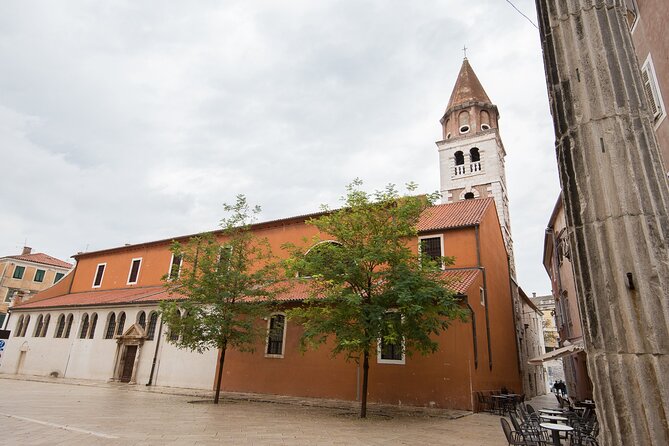
St Simeon: the mummified Simeon and a silver casket
Then it gets dramatic—in a historic way. At the Church of St Simeon in Zadar, there’s a silver casket holding the mummified body of Simeon the God-receiver (Šimun/Šime). The church’s story connects to the New Testament Gospel of Luke, when Simeon greets the child Jesus in the Jerusalem temple.
Why this matters for your walk: it shows how Zadar’s identity is tied to specific saints and relics, not just architecture. Even the fact that this is Zadar’s patron saint ties the object to the city itself.
The casket is considered the most valuable work of Medieval goldsmith art in Croatia, which is a big claim—but even if you don’t want to get lost in art-nerd details, you’ll feel the weight of what you’re looking at.
More tastings from the Ravni Kotari vineyards and the Zadar table.




Five Wells and Queen Jelena’s park: water defense turned public space
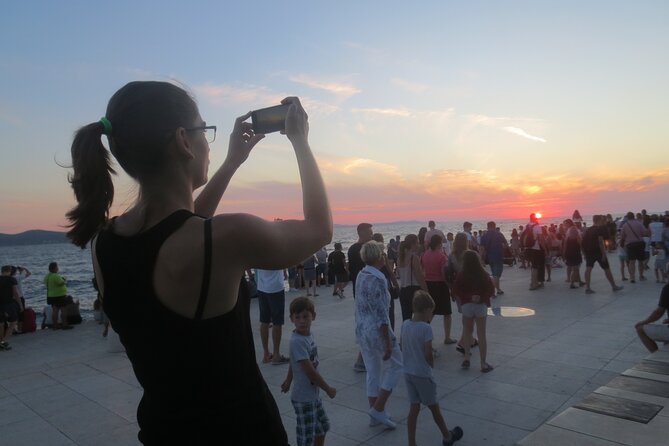
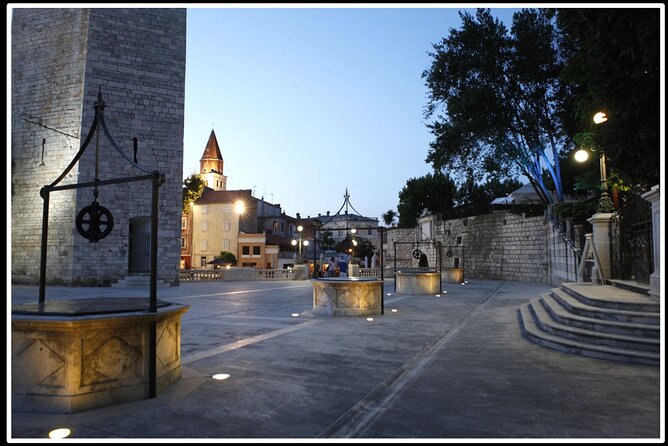
At Five Wells, you learn why this square has its name. The site sits between medieval city walls and the Renaissance bastion Grimani, and below the old walls there was a defensive ditch. In the 16th century, Venetians helped Zadar withstand Turkish sieges by building a large water cistern, capped with five ornamental wellheads.
So you’re not just looking at a pretty row of wells. You’re seeing a city survival plan made ornamental.
Then the walk continues up to Perivoj kraljice Jelene Madijevke (Queen Jelena Madijevka park). The park sits on top of the Grimaldi bastion where Five Wells Square is located. It was founded in 1829 by Austrian commander Baron Franz Ludwig von Welden, a passionate botanist who admired Dalmatian flora. It was also the first public park in Dalmatia—an unusual idea, planting a garden on top of military infrastructure.
For a walking tour, this stop is practical as well as interesting. It’s one of the better spots to cool off for a minute, rehydrate, and reset before you head back into the denser streets.
Trznica Zadar market: where the city eats and shops
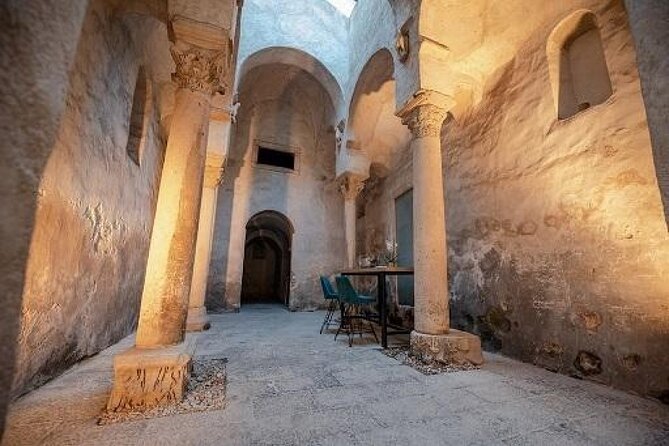
Next up is Trznica Zadar, Zadar’s main green market in the old part of town. The guide frames it as one of the most important traditional urban-life spaces in Zadar, with an uninterrupted history as long as the market’s location and role in the city.
It’s useful to know the timeline here: the market has been in its current place since 1952, even though the broader location connects to an older Roman Forum setting. In other words, you’re walking through an area that stayed important long after the Romans left.
Expect a real-market feel: locally grown organic food, fruits and vegetables, freshly caught fish, home-grown meat, and traditional local products and souvenirs. This is the part where Zadar stops being theory and becomes daily life.
Because the tour is sponsored by Gligora Cheese and deli, the walk often includes a cheese-focused moment—one of the best-loved bits from past tours. If you like tasting something you can also buy later, this is usually the most fun part of the route. Either way, the guide’s recommendations for where to eat and shop tend to make the rest of your stay easier.
St Chrysogonus (St Krsevan): a Romanesque church with royal intrigue
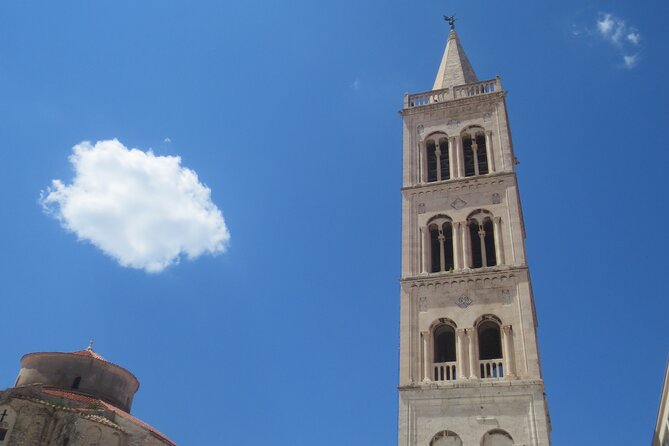
The Church of St Chrysogonus (Crkva sv. Krševana) is a Romanesque Roman Catholic church named after the city’s patron saint. The church was consecrated in 1175 by Lampridius, Archbishop of Zadar, and it was built at the site of a Roman emporium.
You’ll also hear how it replaced the Church of Saint Anthony the Hermit and became the only remaining part of a larger medieval Benedictine abbey. That’s a useful detail: it explains why you’re seeing one building that feels “too important” compared to the rest of what’s around it.
Here’s the story you won’t forget: in 1387, Elizabeth of Bosnia—the murdered queen dowager of Hungary and Dalmatia—was secretly buried in the church. Her body stayed there for three years until it was moved to the Székesfehérvár Basilica.
The bell tower story adds another layer. Construction began in 1485, but it was abandoned in 1546 and never finished. That unfinished feel can be a nice reminder: even big plans in Zadar didn’t always reach the end.
Cathedral of Saint Anastasia: relics, reconstruction, and a peek when closed
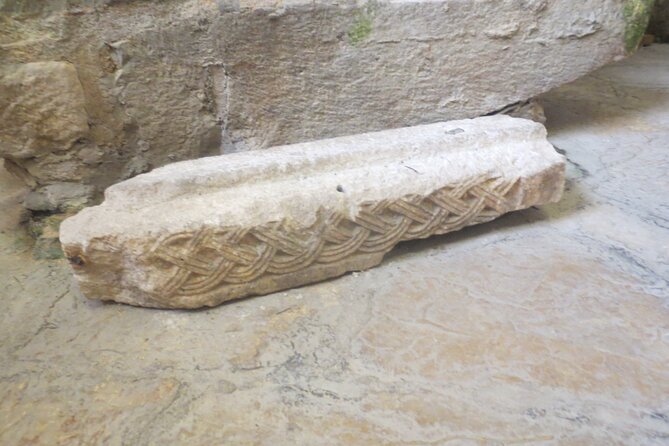
Zadar’s Cathedral of Saint Anastasia was built in the 12th and 13th centuries. Outside, it has a richly decorated facade; inside, it’s a three-nave church with remnants of frescoes in side apses.
A key part of the cathedral’s story is WWII. It was badly bombed, then reconstructed afterward, so what you see today carries the scars of modern history as well as medieval design.
On the altar in the left apse is a marble sarcophagus with the relics of St Anastasia. The choir has lavishly carved stalls, and that detail is usually what gives the cathedral its “stop-and-look” effect.
If the cathedral is closed, you can still peer inside thanks to a glass vestibule. It’s a small feature, but it keeps the tour flowing instead of forcing you to stand around hoping for access.
St Donatus and the Roman Forum: the city where ruins sit under churches
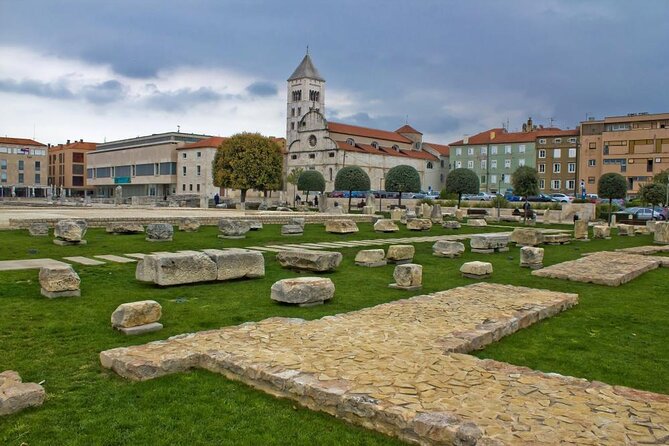
Zadar has a special trick: Roman ruins seem to pop up randomly from the streets. You see it clearly at the ancient Forum site, built between the 1st century BC and the 3rd century AD, which served as the center of civic and religious life.
St Donatus’ Church dominates one side of that Forum area. That’s the payoff of the route: you’re not only “visiting a church.” You’re watching how one era uses the footprint of another.
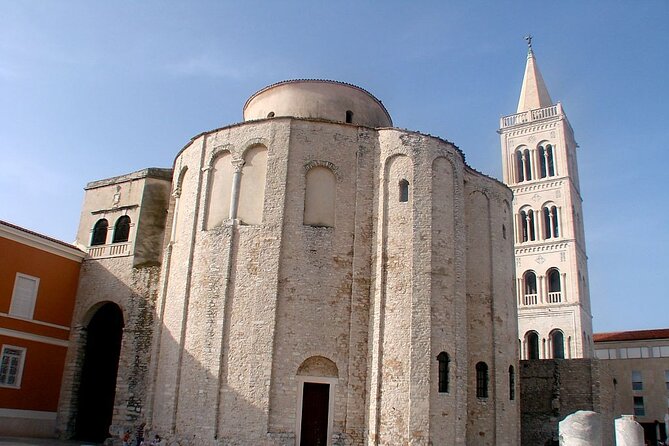
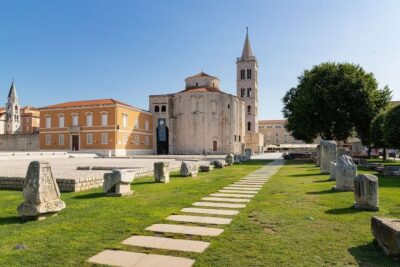
St Donatus’ Church dates from the beginning of the 9th century and is a circular Byzantine-style church named after the bishop who commissioned it. It also survived the Mongol invasion of the 13th century, and it’s one of only a handful of buildings from the early Croatian kingdom that made it through.
Inside, you get recycled Roman materials—two complete Roman columns, plus paving slabs that were revealed after the original floor was removed. The interior isn’t overly decorated, so the recycled elements and the simple structure do a lot of the talking.
Also, it hasn’t been used for services for around 200 years. These days it often serves as a concert hall or exhibition space, which means the building still has a job—just not the one it originally had.
Pace, weather, and what 90 minutes actually feels like
The tour runs about 1 hour 40 minutes. The stops are spaced out in a way that gives you short view-time at each landmark (often around 5–10 minutes), plus the time to walk between.
That pace is usually perfect for first-time visitors. You get broad coverage: Narodni trg, St Simeon, Five Wells, Queen Jelena’s park, Trznica market, St Chrysogonus, the Cathedral of St Anastasia, and then St Donatus and the Forum area.
Weather can be the one limiter. One past tour noted September heat and walking between buildings with little breeze. So if it’s warm when you go, plan for sun protection—water and a hat help more than you think, because you’re outside most of the time.
If you hate rushing, you might wish for more time at the cathedral or the market. Still, the trade-off is that you leave with clear orientation for the rest of your Zadar days.
Price and value: what you really pay for
At about $18.14 per person, this tour is priced like a budget-friendly introduction, not a premium private experience. And in this case, the value comes from how many big-name sights you cover in one guided loop.
Several of the stops involve no paid admission for you to worry about, and you’re getting guided context so those monuments don’t blur together. On top of the architecture, the guide focuses on practical Zadar living—especially where to eat and shop—so you’re likely to save time later.
The other value driver is the sponsor connection. With Gligora Cheese and deli, there’s typically a cheese-and-deli moment built into the experience, and that’s a favorite highlight from past groups.
When might it not be the best match? If you already plan to do a self-guided deep dive on every church and relic, you may find the tour’s pace a bit brisk. But for most people trying to orient themselves quickly, it’s a smart spend.
Who it fits best: history lovers, first-timers, and families
This is a strong fit if you’re a first-time visitor who wants the main landmarks in the right order. It’s also a good choice for history buffs because the route connects the dots: medieval power at Narodni trg, survival-defense water systems at Five Wells, religious relics at St Simeon, and Roman reuse inside St Donatus.
It also works well for families. Past tours included kids with questions, and the guides adapted to keep younger minds engaged.
If you travel with a service animal, service animals are allowed. And because the meeting point is by public transport and the route stays in central old-town areas, it’s easy to slot into your day.
Should you book the Zadar Walking Tour?
If your goal is to understand Zadar fast—and not just see photos—book it. The route is tight, the focus is practical, and the guide adds stories that help the streets make sense. I also like that you get a mix of major sights and real-life market energy at Trznica Zadar, with a cheese-and-deli angle tied to Gligora.
If you’re the type who hates group pacing or you want to linger for hours in museums, you might prefer a longer self-guided day. Otherwise, this is one of the easiest ways to turn 1.5 hours into a foundation for the rest of your trip.
FAQ
How long is the Zadar Walking Tour?
The tour lasts about 1 hour 40 minutes.
Where does the tour meet?
The meeting point is People’s Square, Narodni trg, 23000, Zadar, Croatia, and the tour ends back at the meeting point.
Is the tour offered in English?
Yes. The tour is offered in English.
How big is the group?
The tour has a maximum of 30 travelers.
Are there different departure times?
Yes. You can choose from three morning or afternoon departures.
Do I need to pay for entry to the sights?
No paid admission is listed for the stops, and the tour details indicate admission tickets are free.
Is there a cheese or food element to the tour?
Yes. The tour is sponsored by Gligora Cheese and deli, and the market stop is part of the experience, with food and shopping recommendations included.
Are service animals allowed?
Yes. Service animals are allowed.
What is the cancellation window?
You can cancel for a full refund up to 24 hours before the experience’s start time.
More Tour Reviews in Zadar



More Wine & Food Tastings



More Old Town Walks
After something else? More tours and days out around Zadar




Zadar Old Town Walking Tours, compared.
 ★ 4.9Plitvice Lakes with Boat Ride and Zadar Old Town TourFrom $531,368 reviews
 ★ 5.0Plitvice Lakes with Boat Ride & Zadar Old town tourFrom $541,129 reviews
 ★ 4.8Guided Walking TourFrom $17445 reviews
 ★ 5.0Krka Waterfalls, Food & Wine Tasting, Boat Ride & Zadar Old TownFrom $52420 reviews
 ★ 5.0Zadar City Tour 120min WalkFrom $32203 reviews
 ★ 4.4Virtual Reality Guided History Walking TourFrom $3586 reviews
 ★ 4.7Private Walking Tour Through 3,000 Years of HistoryFrom $28871 reviews
 ★ 4.8Culinary Walking Tour with Food TastingsFrom $12863 reviews
Browse the lists this tour appears in